

Cloud simulators and emulators do not include microphone, camera, Bluetooth,
NFC, Face ID, fingerprint, or pinch-to-zoom. See Mobile App Testing
limitations for the full list
of what you can and cannot test.
Testing a web app?
See the Web POC Setup Checklist for
staging URLs, email whitelisting, and browser authentication.
Before kickoff: verify these are ready
What to verify, and effort if not ready
Work through these in order. Backend IP allowlisting usually takes the longest when IT is involved.1. Enable mobile testing
Mobile testing is enabled per organization. Contact support or your QA.tech contact to enable it before the POC.2. Backend network access
Mobile tests run on cloud emulators. API calls from the app exit through a separate set of IP ranges from web testing.Mobile testing IPs
Get the current list from Settings → Network. Use the Mobile Testing IP Whitelist section. Mobile testing uses different IP ranges than web testing. Add those ranges wherever your mobile backend enforces access:- Backend firewall or security group (AWS, GCP, Azure)
- API gateway allowlist or rate-limiting rules
- VPN / zero-trust gateway (Tailscale, Cloudflare Access, Zscaler)
Your team verifies
- The app can reach your staging API from outside your corporate network
- IT has applied the mobile IP allowlist to the correct backend endpoints
QA.tech verifies during setup
- App launches on the emulator and loads past the splash screen
- Login and API-dependent flows complete without network errors
3. App build
Mobile testing requires a simulator or emulator build, not an App Store or Play Store distribution build.- iOS
- Android
Build for iOS Simulator and compress the Locate the Upload the
.app as .zip or .tar.gz..app in build/Debug-iphonesimulator/, then:.zip (max 4 GB). App Store .ipa files are not supported.Tests run on cloud iOS Simulators and Android Emulators. Configure simulators
and emulators with mobile device
presets. Physical device
testing is coming soon.
Your team verifies
- The build installs and launches on a local simulator/emulator
- The build points at your staging backend (not production)
4. Test accounts & auth
Same principles as web testing:- Create dedicated staging accounts for each role
- Verify login works on a local emulator before sharing credentials
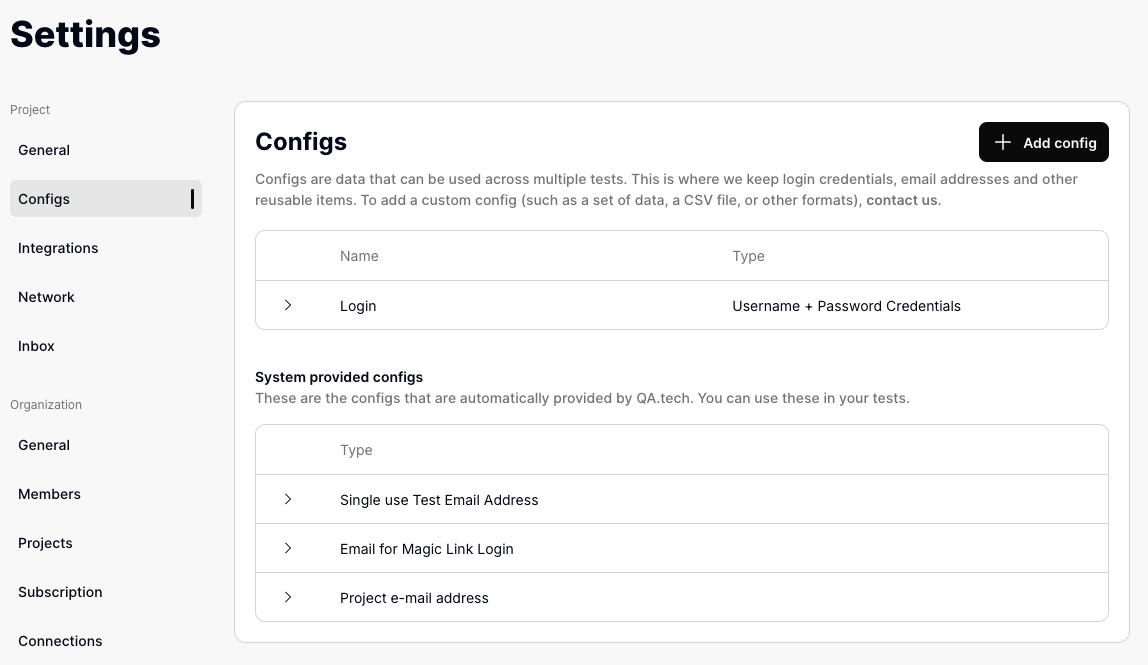
- Share credentials with QA.tech for Configs, or send them to your contact person at QA.tech who will add them for you
5. QA.tech project setup
QA.tech handles this during onboarding:1
Create a mobile application
Settings → Applications &
Envs → new
application → type Mobile App
2
Add an environment
Select iOS or Android and name the environment (for example,
Staging). No URL is required.
3
Upload the build
iOS:
.zip / .tar.gz with simulator .app · Android: .apk4
Run smoke tests
QA.tech verifies the app launches, can log in, and reaches your backend.